What Is BaZi? Your Four Pillars of Destiny Explained
What is BaZi? Learn how the Four Pillars of Destiny works, what your chart reveals about personality and life path, and how to get your free bazi chart reading.
What Is BaZi, Really?
Imagine this: two babies born in the same hospital, same day, just hours apart. One grows up to become a restless entrepreneur who can't sit still. The other becomes a meticulous researcher who spends decades on a single topic. BaZi would say the difference is written in their birth charts.
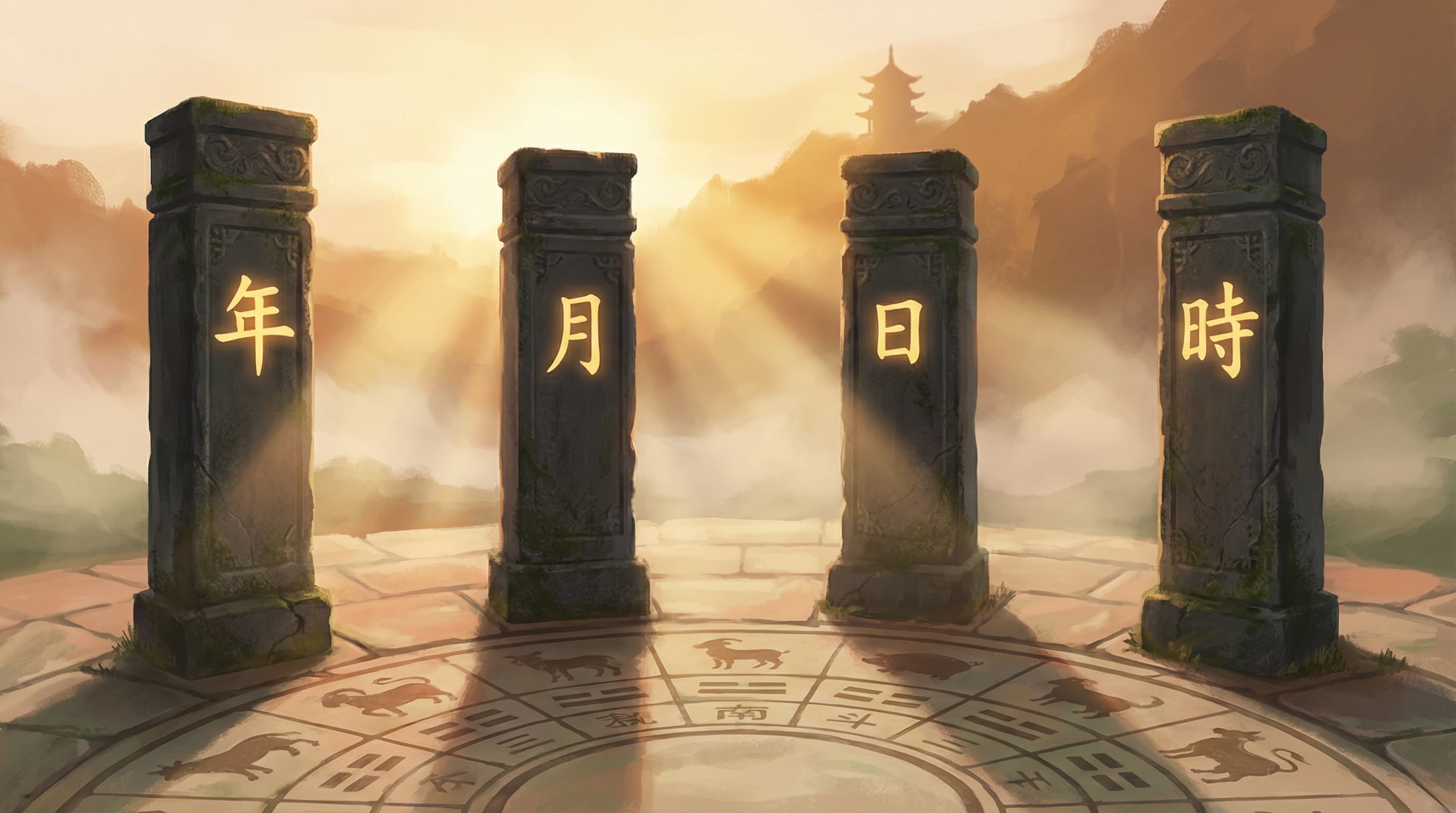
BaZi (八字) literally means "Eight Characters." It's the Chinese astrology system also called the Four Pillars of Destiny (四柱命理), and it maps your personality, strengths, and life trajectory based on the exact time you were born. Not your zodiac animal alone -- the full picture.
The system has been in continuous use for over a thousand years across China, Taiwan, Hong Kong, Singapore, Malaysia, and beyond. While Western astrology looks at where the planets were when you were born, BaZi works from the Chinese calendar and the philosophy of Yin-Yang and the Five Elements in BaZi (Wu Xing). Different system, different lens, surprisingly specific results.
How to Find Your Own BaZi Chart
Your BaZi isn't your Western birthday written in Chinese. It has to be converted into the Chinese solar calendar first:
- Year Pillar: the year changes at Start of Spring (Li Chun, around February 4), not on January 1 or Chinese New Year.
- Month Pillar: months follow the 24 solar terms, so the month can differ from the calendar month you were born in.
- Day and Hour Pillars: the day comes from the 60-day stem-branch cycle, and the hour from your two-hour birth block. Birth time and place matter here, especially near midnight (Zi hour).
Doing this by hand is where most mistakes happen. Enter your birth date and time to get your Four Pillars, Day Master, and Five Elements balance: the chart also labels the Ten Gods, hidden stems, and your 10-year Luck Pillars. The basic chart is free, with no sign-up. If you don't know your birth hour, the calculator only gives a date-only candidate preview instead of a full chart.
How a BaZi Chart Works
A bazi chart is built from four "pillars," each made of two Chinese characters -- one Heavenly Stem on top, one Earthly Branch below. Four pillars, two characters each, eight characters total. That's where the name comes from.
| Pillar | What It Represents |
|---|---|
| Year Pillar | Your social environment, ancestry, early childhood influences |
| Month Pillar | Career direction, relationship with parents, your prime working years |
| Day Pillar | Your core self (the Day Master) and your closest relationships, especially marriage |
| Hour Pillar | Children, aspirations, your inner world, and the later stages of life |
Each pillar pairs a Heavenly Stem (天干) with an Earthly Branch (地支). There are 10 Stems and 12 Branches, and they cycle through combinations the way a clock cycles through hours -- except this clock takes 60 years to complete one full rotation.
The 10 Heavenly Stems
Each Stem belongs to one of the Five Elements, in either Yang or Yin form:
- Wood: 甲 (Jia, Yang) and 乙 (Yi, Yin)
- Fire: 丙 (Bing, Yang) and 丁 (Ding, Yin)
- Earth: 戊 (Wu, Yang) and 己 (Ji, Yin)
- Metal: 庚 (Geng, Yang) and 辛 (Xin, Yin)
- Water: 壬 (Ren, Yang) and 癸 (Gui, Yin)
The 12 Earthly Branches
You probably know these as the Chinese zodiac animals:
子 (Rat), 丑 (Ox), 寅 (Tiger), 卯 (Rabbit), 辰 (Dragon), 巳 (Snake), 午 (Horse), 未 (Goat), 申 (Monkey), 酉 (Rooster), 戌 (Dog), 亥 (Pig)
But in bazi chart reading, these animals are just the surface. Each Branch contains hidden elements inside it that add layers of meaning to your chart. If you want to go deeper, our guide on how to read a BaZi chart walks through each layer step by step.
The Day Master: Who You Actually Are
Here's the thing most beginners miss: your Chinese zodiac animal (the Year Branch) is only one-eighth of your chart. The real center of your identity in BaZi is the Day Master (日主) -- the Heavenly Stem of your Day Pillar.
Your Day Master is you. Everything else in the chart -- the other elements, their interactions, the timing of your luck cycles -- gets interpreted relative to this single character.
Say your Day Master is 甲 (Jia Wood). You're like a tall tree: ambitious, principled, always reaching upward. If it's 癸 (Gui Water), you're more like morning dew -- quiet, perceptive, surprisingly persistent. Same birth year, same zodiac animal, but these two people approach life in fundamentally different ways.
This is why BaZi is so much more specific than just "I'm a Dragon" or "I'm a Rabbit."
Five Elements: The Engine Behind Everything
The Five Elements form the backbone of bazi analysis, and they interact in specific ways:
- Wood feeds Fire, is controlled by Metal
- Fire creates Earth, is controlled by Water
- Earth produces Metal, is controlled by Wood
- Metal generates Water, is controlled by Fire
- Water nourishes Wood, is controlled by Earth
When your chart has these elements in reasonable balance, life tends to flow more smoothly. When certain elements are too strong or completely absent, that's where things get interesting -- those imbalances show up as specific challenges or unusual strengths.
A chart heavy in Fire but missing Water, for instance, might belong to someone who's brilliantly charismatic but burns out easily. The chart doesn't judge. It describes.
The Ten Gods: Your Relationship Map
BaZi uses a framework called the Ten Gods (十神) to describe how every element in your chart relates to the Day Master. Think of them as roles in the story of your life:
- Wealth elements -- your relationship with money and, for men, romantic partners
- Officer elements -- career authority, discipline, and for women, romantic partners
- Resource elements -- learning, mentorship, support from others
- Output elements -- creativity, self-expression, your ideas going out into the world
- Companion elements -- peers, siblings, competition
When a practitioner says "you have strong Wealth stars," they're not predicting you'll be rich. They're saying your chart emphasizes the theme of resources, acquisition, and material engagement. How that plays out depends on the full chart context.
What Can a BaZi Reading Tell You?
People come to BaZi for all kinds of reasons:
Personality and self-awareness. Why do you keep making certain choices? Why do some environments energize you while others drain you? Your chart often explains patterns you've always noticed but couldn't articulate.
Career direction. Your elemental makeup points toward industries and roles where you'll naturally do well. A strong Metal person thrives in structured, analytical environments. A strong Wood person needs growth and room to build. More on this in our bazi career guide.
Relationship compatibility. Comparing two charts reveals where natural chemistry exists and where friction is likely. This is especially popular for marriage assessment in Chinese culture. You can try our bazi compatibility calculator to see how two charts interact.
Timing. BaZi maps your life into 10-year Luck Pillars (大运), each bringing different elemental influences. This is why someone might struggle in their 20s but thrive after 35 -- the elemental weather changed.
Health patterns. Each element corresponds to specific organ systems. Chronic imbalances in your chart can point to areas worth paying attention to.
BaZi vs. Western Astrology
People often ask how BaZi compares to the horoscopes they already know. Here's the short version:
| BaZi | Western Astrology | |
|---|---|---|
| Based on | Chinese calendar, Five Elements | Planetary positions, zodiac signs |
| Core identity | Day Master (one of 10 types) | Sun sign, Moon sign, Rising sign |
| Prediction method | 10-year Luck Pillars | Transits and progressions |
| Framework | Yin-Yang, Wu Xing, Ten Gods | 12 Houses, planetary aspects |
They're different systems asking similar questions. Many people find value in both.
Start With Your Own Chart
Traditionally, calculating a bazi chart meant consulting a master who could convert your birthday into the Chinese calendar system by hand. Now you can see your own Day Master and Five Elements balance in seconds -- the same four pillars, Ten Gods, and Luck Pillar timeline a traditional practitioner would work from.
If you've been curious about Chinese astrology but didn't know where to start, your own chart is the best starting point. The patterns you'll recognize in yourself are usually the hook that makes everything else click.
Frequently Asked Questions
Is BaZi the same as Chinese astrology?
BaZi is one branch of Chinese astrology, but not the only one. Chinese metaphysics also includes Zi Wei Dou Shu (Purple Star Astrology), Feng Shui, and the I Ching. BaZi specifically uses the Four Pillars derived from your birth date and time, while Western astrology uses planetary positions. They are different systems with different foundations.
How accurate is BaZi?
BaZi describes tendencies and patterns, not fixed outcomes. An experienced practitioner can identify personality traits, career aptitudes, and relationship dynamics with remarkable accuracy. However, BaZi shows the landscape of your life -- the choices you make within that landscape are still yours.
Do I need my exact birth time for a BaZi reading?
The birth time determines the Hour Pillar and can also affect other pillars near a solar-term transition or late-Zi boundary. If the whole hour is unknown, use our free BaZi calculator and chart generator only for its date-only candidate preview. It does not substitute noon and does not save a complete chart. The Year, Month, or Day Pillar may vary across candidates. The Spouse Palace is stable only when the Day Branch matches every candidate, and Luck-cycle timing remains uncertain until the birth hour or a reliable range is confirmed.
Can BaZi predict the future?
BaZi identifies favorable and challenging periods through Luck Pillars (10-year cycles) and annual influences. It does not predict specific events but highlights when conditions are ripe for certain types of experiences -- career changes, relationship shifts, health concerns. Think of it as a weather forecast for your life, not a script.
🔮 Curious about your BaZi chart?
Get your free Four Pillars chart, Five Elements and Ten Gods. Explore optional AI reports and review the cost before generating.
Author
Categories
More Posts

DeepSeek BaZi Reading: Why It Fails (And What Works Better)
DeepSeek can explain a calculated BaZi chart, but it should not derive Four Pillars from raw birth data. Learn the calendar boundaries and use a reproducible workflow.
Seven Killings in BaZi: Meaning, Traits & Eating God Pattern
Seven Killings in BaZi explained: personality traits, career pressure, relationship patterns, and the Eating God Controls Killings structure.

BaZi Career Guide: Find Work That Fits Your Chart
Use this bazi career guide to match your favorable element and Ten Gods to the right industry, role, and timing. Practical career advice from Chinese astrology.
Newsletter
Get new guides by email
New articles on BaZi, compatibility and Zi Wei Dou Shu, plus product updates, sent to your inbox.