Five Elements in BaZi: Wood, Fire, Earth, Metal & Water
A clear Five Elements (Wu Xing) guide for BaZi: Wood, Fire, Earth, Metal, Water, the generating and controlling cycles, Day Master lookup, and responsible interpretation.
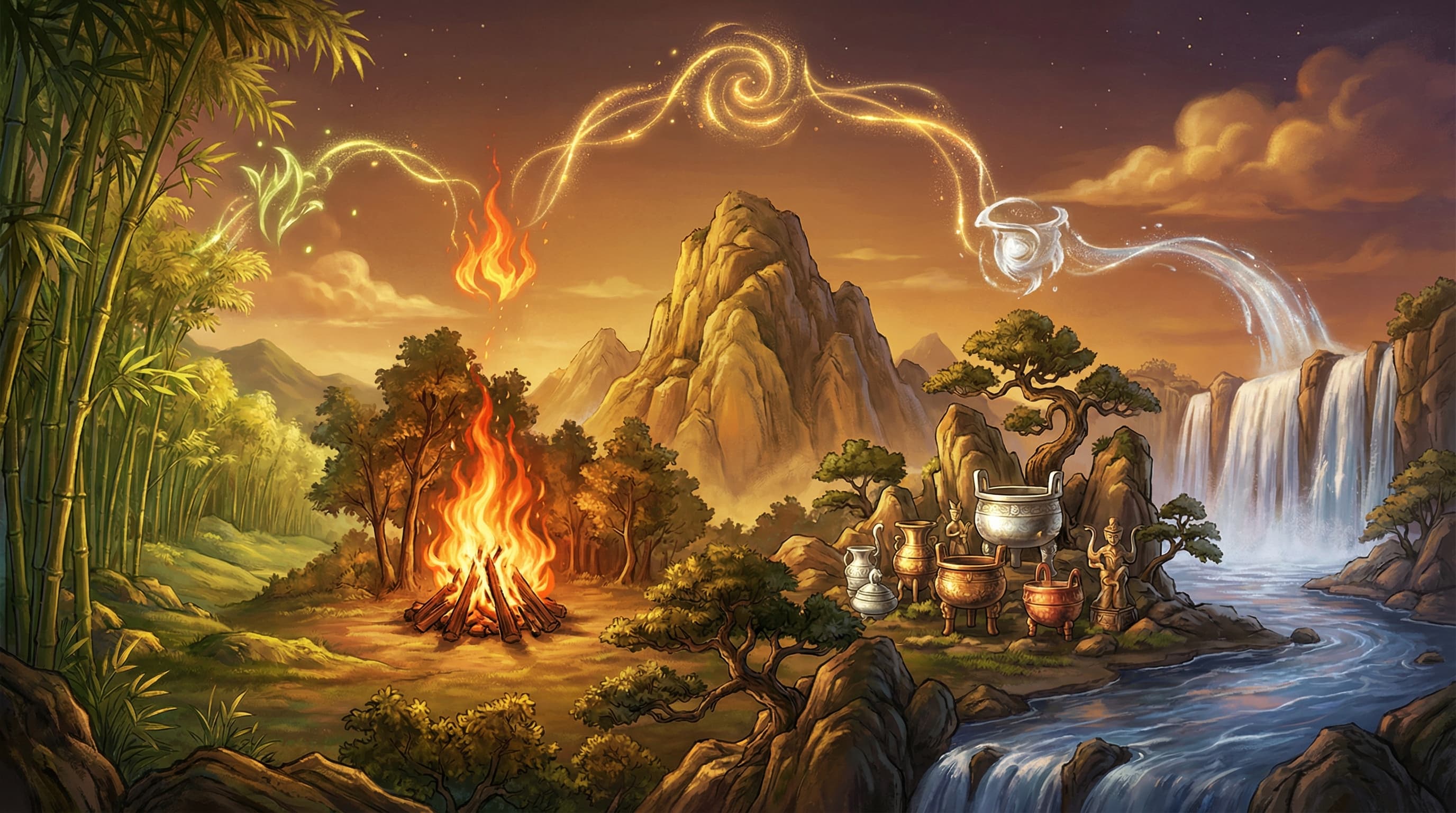
What Are the Five Elements in BaZi?
The Five Elements, or Wu Xing (五行), are Wood, Fire, Earth, Metal, and Water. In BaZi, they classify Heavenly Stems, Earthly Branches, seasons, and relationships between chart components. The word xing is closer to a phase or mode of change than five literal substances.
Your Day Master's element comes from the Heavenly Stem of the Day Pillar. A complete reading then considers all Four Pillars, hidden stems, season, combinations, and relative strength. Enter your birth date to find your element and what is missing: the result shows your Day Master element and your Wood, Fire, Earth, Metal and Water percentages. For the full chart with luck cycles, use the BaZi calculator; new to the terms? Read what BaZi is first.
Interpretation boundary: Wu Xing here is a traditional symbolic framework. It is not a scientifically validated personality, career, or health assessment, and it cannot establish ability, relationship quality, disease risk, or future outcomes.
Five Elements Quick Reference
| Element | Yin/Yang Stems | Traditional season | Traditional symbolic themes | Reflection prompt |
|---|---|---|---|---|
| Wood 木 | 甲 Jia / 乙 Yi | Spring | Growth, direction, flexibility | What am I developing, and what plan supports it? |
| Fire 火 | 丙 Bing / 丁 Ding | Summer | Visibility, expression, transformation | What needs to be communicated more clearly? |
| Earth 土 | 戊 Wu / 己 Ji | Seasonal transitions | Stability, support, continuity | What routine or commitment needs a firmer base? |
| Metal 金 | 庚 Geng / 辛 Xin | Autumn | Structure, standards, refinement | What should be simplified, measured, or bounded? |
| Water 水 | 壬 Ren / 癸 Gui | Winter | Movement, inquiry, adaptability | Where should I listen, research, or adjust? |
Traditional texts use natural images to distinguish Yang and Yin expressions: Jia Wood as a tree and Yi Wood as a vine; Bing Fire as the sun and Ding Fire as a lamp; Wu Earth as a mountain and Ji Earth as cultivated soil; Geng Metal as ore or a blade and Xin Metal as refined metal; Ren Water as a river or ocean and Gui Water as rain or dew.
These images are vocabulary for reading chart relationships. They are not evidence that everyone with the same Day Stem shares a fixed temperament. Use them as hypotheses and compare them with observed behavior.
The Generating Cycle (相生)
The traditional generating sequence is:
Wood → Fire → Earth → Metal → Water → Wood
| Relationship | Traditional image |
|---|---|
| Wood generates Fire | Wood can fuel flame |
| Fire generates Earth | Burning leaves ash |
| Earth generates Metal | Minerals form within earth |
| Metal generates Water | Traditional imagery associates metal with collecting water |
| Water generates Wood | Water supports plant growth |
In a BaZi reading, “generates” describes the formal relationship between two element categories. It does not by itself prove that a life area will progress smoothly.
The Controlling Cycle (相克)
The traditional controlling sequence is:
Wood → Earth → Water → Fire → Metal → Wood
| Relationship | Traditional image |
|---|---|
| Wood controls Earth | Roots divide soil |
| Earth controls Water | Banks contain water |
| Water controls Fire | Water extinguishes flame |
| Fire controls Metal | Heat reshapes metal |
| Metal controls Wood | A blade cuts wood |
Control is part of the system, not automatically a negative verdict. BaZi schools compare strength, season, combinations, and the role each element represents. The Five Elements clash guide explains this cycle in more detail.
How to Find Your BaZi Element
- Generate your Four Pillars with the BaZi calculator.
- Locate the Heavenly Stem of the Day Pillar.
- Map that stem to its element: Jia/Yi Wood, Bing/Ding Fire, Wu/Ji Earth, Geng/Xin Metal, or Ren/Gui Water.
- Read the full distribution before calling any element “dominant,” “weak,” or “favorable.”
The Day Master identifies the reference point, but it is not a complete personality type. Two people with the same Day Stem can have very different charts and life histories. Our guide to reading a BaZi chart covers the surrounding structure.
Personality, Career, and Relationships: A Responsible Use
Five Element themes can organize reflection, but they should not replace evidence:
- Personality: compare a symbolic theme with repeated behavior, feedback, and context rather than assuming it is innate.
- Career: evaluate skills, interests, constraints, labor-market evidence, and trial projects. An “element industry” is a traditional association, not a job-fit test.
- Relationships: use element language to open a conversation about pace, boundaries, expression, or stability. It cannot measure compatibility or predict whether a couple will last.
- Timing: Luck Pillars and annual elements are traditional interpretive layers, not guarantees that a period will be easy or difficult.
Can BaZi Five Elements Assess Health?
No. Traditional Chinese medicine historically associates elements with organ systems, but a BaZi chart is not a medical measurement. Element abundance, absence, generation, or control cannot diagnose a condition or identify which organ will become ill.
The U.S. National Center for Complementary and Integrative Health explains that evidence across traditional Chinese medicine approaches is mixed and that some products may have serious safety issues: Traditional Chinese Medicine: What You Need To Know.
Use symptoms, examination, tests, and qualified clinical advice for health decisions. Do not alter medication, supplements, diet, or screening because of a chart interpretation.
Frequently Asked Questions
What are the Five Elements in order?
The generating order is Wood, Fire, Earth, Metal, Water, then back to Wood. The controlling order is Wood controls Earth, Earth controls Water, Water controls Fire, Fire controls Metal, and Metal controls Wood.
How do I know which element I am?
In BaZi, the Day Pillar's Heavenly Stem gives the Day Master element. The full chart still matters when discussing distribution or traditional strength. A BaZi calculator can show both.
Is one element better than another?
No. The five categories have different roles within the traditional model. A chart percentage is not a score of personal quality, talent, or life potential.
Can Five Element balance change over time?
The natal chart stays fixed within the chosen calculation convention. Traditional readings add Luck Pillars and annual influences as changing context, but those layers do not guarantee real-world events.
What does a missing element mean?
It means the element is absent from the positions counted by the displayed chart calculation. It does not mean the person lacks that quality. See the detailed guide to missing elements in BaZi.
Author
Categories
More Posts

What Does Hong Yan Sha Mean? BaZi Lookup & Love Myths
What does Hong Yan Sha (Red Beauty Star) mean in BaZi? See the Day Stem lookup, school differences, and why it does not prove attraction or bad romance.

AI Zi Wei Dou Shu: 3 Ready-to-Use Prompts for ChatGPT, Claude and DeepSeek
Want ChatGPT, DeepSeek or Claude to read your Zi Wei Dou Shu (Purple Star Astrology) chart? Calculate the chart with a proper tool first, then paste the chart text into the AI. Three prompts you can copy, plus how to tell when the AI is making things up.

BaZi Element Lookup: How to Find Your Five Element Attribute
Step-by-step guide to finding your BaZi Five Element attribute. Heavenly Stems and Earthly Branches element lookup table, Day Master vs Nayin elements explained.
Newsletter
Get new guides by email
New articles on BaZi, compatibility and Zi Wei Dou Shu, plus product updates, sent to your inbox.