DeepSeek BaZi Reading: Why It Fails (And What Works Better)
DeepSeek can explain a calculated BaZi chart, but it should not derive Four Pillars from raw birth data. Learn the calendar boundaries and use a reproducible workflow.

DeepSeek and BaZi: What's the Hype About?
Since DeepSeek R1 launched, many users have pasted their birth dates into the chatbot and asked for BaZi readings. The answers can sound coherent even when the underlying Four Pillars have not been calculated reproducibly.
The trend of "cyber fortune-telling" (赛博算命) has taken off, with users sharing their DeepSeek BaZi analyses on social media. But how well does a general-purpose LLM actually handle the complex calculations behind Four Pillars of Destiny?
How to Use DeepSeek for a BaZi Reading
Split the job in two: a calculator works out the chart, DeepSeek explains it.
- Calculate the Four Pillars first. Use the birthplace's local civil time. Don't ask the chatbot to convert the calendar.
- Copy the chart facts: the eight characters, the Five Elements distribution, the Ten Gods, and your current Luck Pillar.
- Paste them into DeepSeek with a clear prompt, for example: "Interpret only the chart below. Do not recalculate it." A full prompt template is in the FAQ at the end.
Enter your birth date to get your Four Pillars, Ten Gods and Luck Pillars to paste into DeepSeek: the basic chart is free and needs no signup. If the birth is near an Hour Pillar boundary and you intentionally follow a true-solar-time convention, turn on the optional check with the actual birth city or coordinates confirmed.
What DeepSeek Gets Right
DeepSeek, like other large language models, can generate fluent Chinese explanations. That makes it useful for exploring an already-calculated chart, but fluency is not evidence that its calendar conversion is correct. It can:
- Explain BaZi concepts clearly. Ask DeepSeek about Ten Gods or Five Elements, and you'll get solid educational content.
- Provide general personality descriptions. Given a birth date, it can produce plausible readings that feel personal.
- Discuss BaZi theory. It handles questions about element interactions, pillar relationships, and classical patterns reasonably well.
Where DeepSeek Falls Short
The core problem: BaZi requires precise astronomical calculations, not pattern matching.
Calendar conversion errors. Converting a Gregorian birth date to the Chinese sexagenary cycle (Heavenly Stems and Earthly Branches) requires exact solar-term calculations. LLMs can get these wrong, especially near solar-term boundaries where a small timing difference can change a pillar.
Inconsistent chart generation. Ask DeepSeek the same birth date twice and you may get different Four Pillars. A BaZi chart is deterministic -- the same input must always produce the same output. LLMs are probabilistic by nature, which is fundamentally at odds with this requirement.
Mixing civil time with true solar time. True solar time is not the birthplace coordinate itself. Astronomically, it is calculated from the date's equation of time, longitude, and the civil-time-zone meridian. The NOAA calculation specifies those inputs, while the U.S. Naval Observatory explains why apparent solar time varies by longitude and date. BaZi schools do not all use the same time convention, so GuanXiang defaults to birthplace local civil time and provides an optional true-solar-time check only when the user confirms the actual birth city.
No structured analysis framework. Professional BaZi reading follows a systematic process: identify the Day Master strength, analyze the Ten Gods configuration, check for special patterns, then examine the Luck Pillars. DeepSeek tends to jump around, cherry-picking impressive-sounding observations without a coherent framework.
DeepSeek vs. Dedicated BaZi Tools
| Feature | DeepSeek | Dedicated BaZi Calculator |
|---|---|---|
| Chart accuracy | Unreliable | Deterministic, verified |
| True solar time | Usually ignored | Verify near boundaries |
| Ten Gods analysis | Surface-level | Systematic |
| Luck Pillar timeline | Often wrong | 100-year timeline |
| Conversational Q&A | Excellent | Limited |
| Cost | Free | Free to paid |
The Best Approach: Use Both
The smartest approach combines both tools:
- Use a dedicated BaZi calculator to generate a reproducible chart -- Heavenly Stems, Earthly Branches, Ten Gods, and Luck Pillars calculated under one explicit time convention.
- Use DeepSeek (or any LLM) for exploration -- ask follow-up questions about specific patterns in your chart, or get explanations of concepts you don't understand.
This way the chart facts remain reproducible while the language model is used for its actual strength: explanation and follow-up questions.
Further Reading
Want to explore a traditional archetype mapping? The BaZi personality test maps chart symbols to 27 product archetypes for reflection; it is not a validated personality assessment.
FAQ
Can DeepSeek accurately calculate my BaZi chart?
Not reliably. DeepSeek and other LLMs can return incorrect or inconsistent calendar conversions. Use a dedicated BaZi calculator with deterministic sexagenary-cycle rules and an explicit time convention; do not let the language model invent the Four Pillars.
Is DeepSeek better than ChatGPT for BaZi readings?
There is no reproducible basis for saying one general-purpose LLM is always more accurate for BaZi. Both are probabilistic language models, while Four Pillars calculation is deterministic. Compare explanations if useful, but do not ask either model to establish the chart facts.
What's the best DeepSeek BaZi prompt?
Don't ask DeepSeek to compute the chart. First generate the chart with a deterministic calculator — the 8 characters representing your Year, Month, Day, and Hour pillars. Then feed the computed chart to DeepSeek and ask it to analyze the Ten Gods configuration, Five Elements balance, or pattern interpretation. This sidesteps the LLM's calculation weakness and uses its language strength.
Suggested prompt template: "Here is my BaZi chart: [Four Pillars] / [Five Elements distribution] / [Ten Gods]. Please analyze: 1) the overall pattern; 2) suitable career directions; 3) the key themes of my current Luck Pillar (ages X-X)."
What is cyber fortune-telling (赛博算命)?
Cyber fortune-telling refers to the trend of using AI chatbots like DeepSeek, ChatGPT, and others for Chinese metaphysical readings including BaZi, Zi Wei Dou Shu, and feng shui. While entertaining, the accuracy of AI-generated charts varies significantly from dedicated tools built specifically for these calculations.
The same rule applies to Zi Wei Dou Shu: plot and check the chart with the free Zi Wei Dou Shu calculator first, then use the AI Zi Wei Dou Shu prompts so the model only interprets facts that are already calculated.
Author

Categories
More Posts

BaZi Bone Weight Fortune: How It Works and What It Means
How BaZi bone weight is calculated, what the 2.1-7.2 liang score indexes, why table versions differ, and how to read the traditional poems without treating them as predictions.

Missing Elements in BaZi: Meaning, Chart Check & Remedies
Learn how to check for a missing Five Element in a BaZi chart, what missing Wood, Fire, Earth, Metal, or Water means traditionally, and which remedies are symbolic rather than medical.
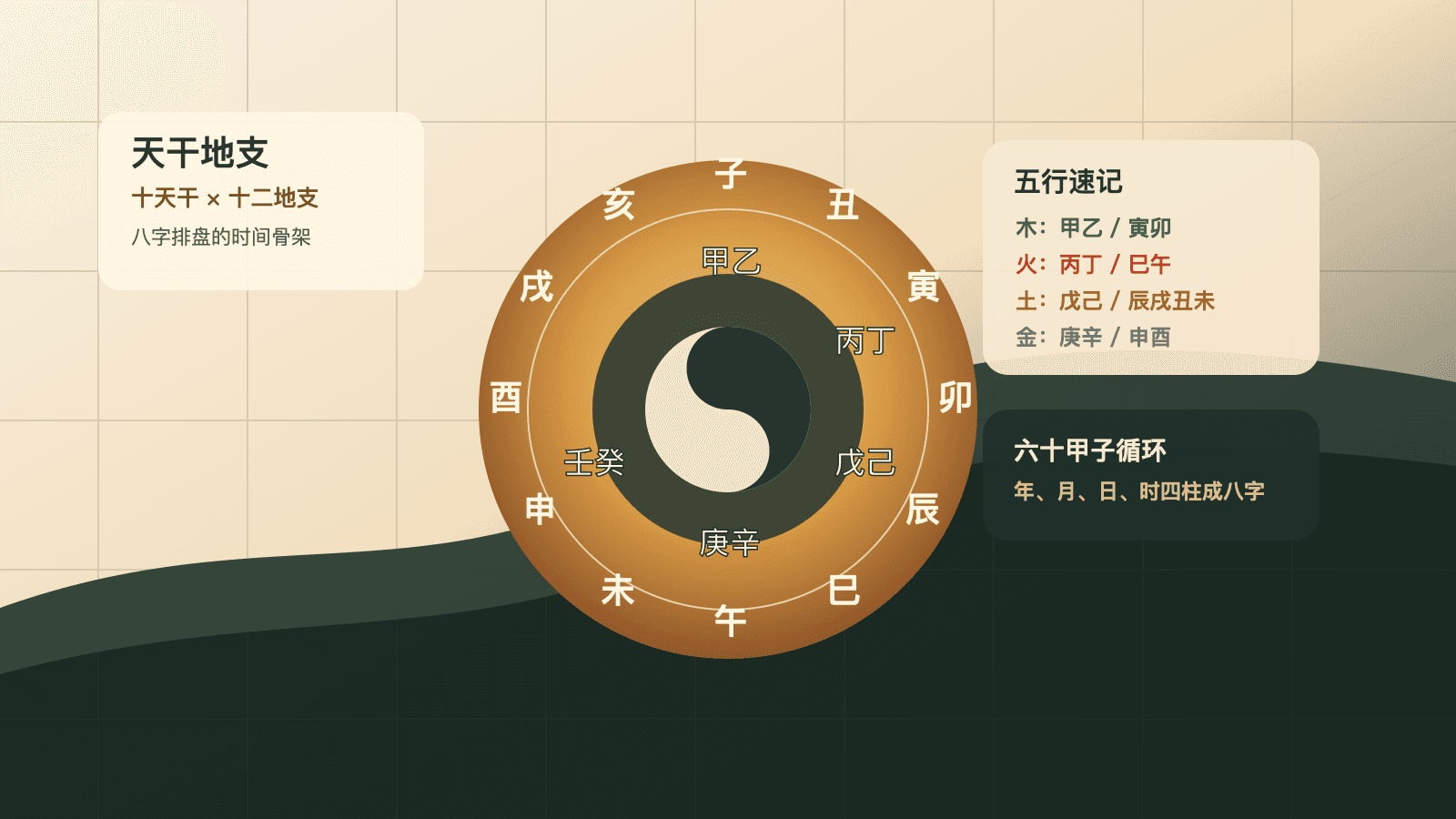
Heavenly Stems and Earthly Branches: Complete BaZi Guide to Gan Zhi
A complete guide to the Heavenly Stems and Earthly Branches in BaZi: the 10 stems, 12 branches, five elements, hidden stems, Chinese zodiac links, the 60 Jiazi cycle, and how they form a BaZi chart.
Newsletter
Get new guides by email
New articles on BaZi, compatibility and Zi Wei Dou Shu, plus product updates, sent to your inbox.