Seven Killings in BaZi: Meaning, Traits & Eating God Pattern
Seven Killings in BaZi explained: personality traits, career pressure, relationship patterns, and the Eating God Controls Killings structure.
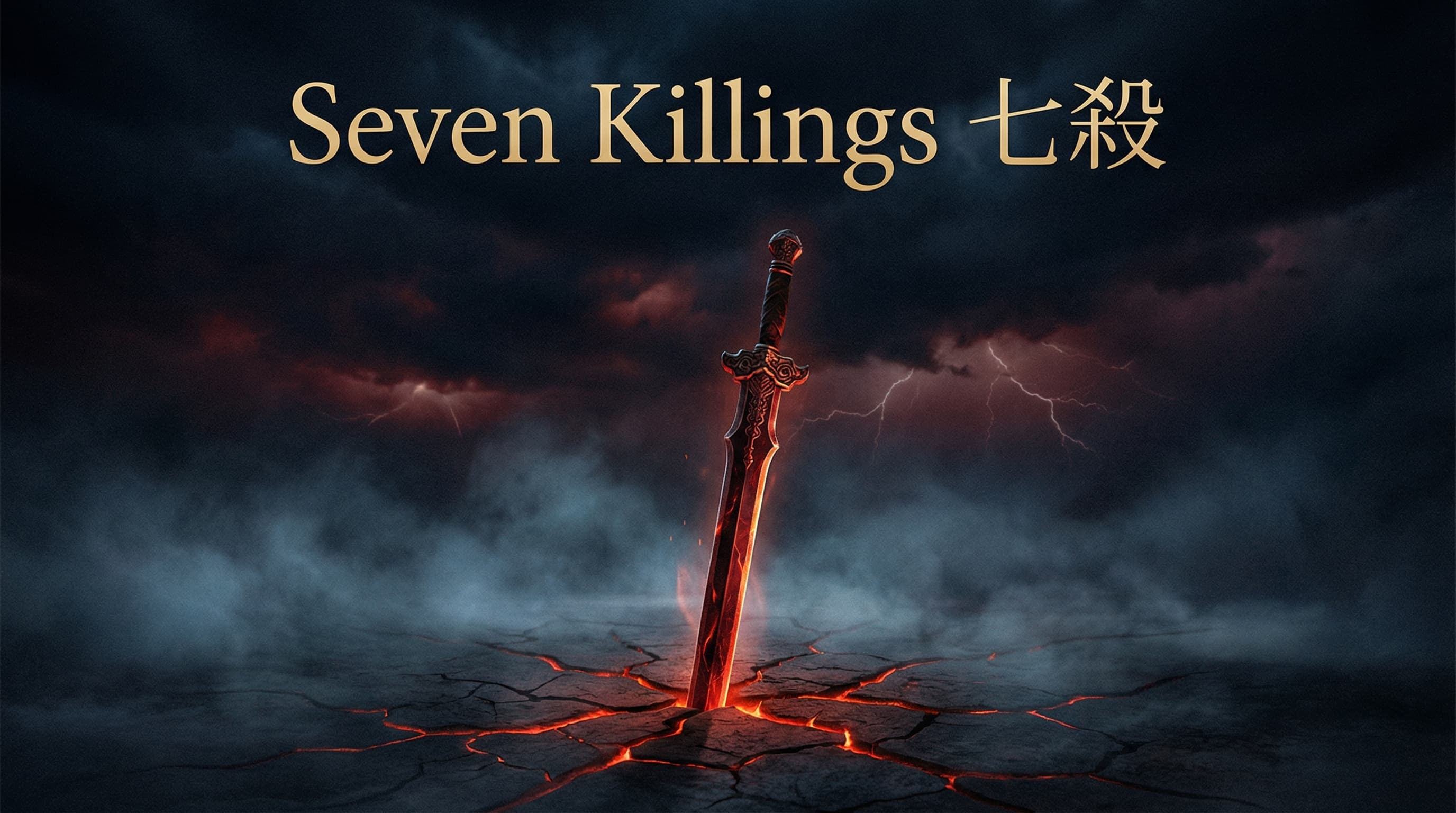
What Is Seven Killings in BaZi?
Seven Killings (七殺, Qi Sha) is one of the Ten Gods in BaZi. It represents the element that controls your Day Master with the same polarity -- Yang controlling Yang, or Yin controlling Yin. This same-polarity clash is what makes Seven Killings so intense: there's no softening buffer, no diplomatic courtesy. It's raw, direct pressure.
If Direct Officer is a boss who manages you through structure and rules, Seven Killings is the drill sergeant who pushes you to your absolute limit. Both exert control, but Seven Killings does it without restraint.
Classical BaZi texts often treated Seven Killings as a force requiring control or transformation. Contemporary readings generally emphasize the full chart rather than assigning a fixed outcome to this star alone.
How to Know If You Have Seven Killings (and a Seven Killings Structure)
Start with your Day Master, the Heavenly Stem of your Day Pillar. Any stem or hidden stem that controls the Day Master with the same polarity is Seven Killings. For example, for a Jia Wood Day Master, Geng Metal is Seven Killings.
Whether it forms a "Seven Killings structure" takes two more checks: does Seven Killings sit in the month branch or appear as an exposed stem with clear strength, and is it moderated by Eating God or transformed by Resource? Counting how many Seven Killings you have won't tell you the structure.
Enter your birth date to see whether your chart has Seven Killings and what share it takes: the calculator labels the Ten God on every pillar, and works out what share of your Ten Gods Seven Killings takes. Prominence tells you which traditional themes receive more interpretive attention; it does not validate a personality profile.
Interpretation boundary: Seven Killings is part of a traditional interpretive framework, not a scientifically validated personality, career, relationship, health, or success test. Use the themes below as prompts for reflection, and use real skills, circumstances, preferences, and evidence for consequential decisions.
Traditional source: Yuan Hai Zi Ping, “On Seven Killings” identifies Seven Killings with Pian Guan and says strength and control must be considered before judging it. The citation documents the historical framework; it is not scientific validation of its outcome claims.
Seven Killings Personality Themes
Traditional readers use prominent Seven Killings as a prompt to examine how someone relates to pressure, competition, urgency, authority, and boundaries. Useful questions include:
- Do deadlines sharpen focus, or create avoidable stress?
- Is directness helping decisions, or crowding out collaboration?
- Does competition create energy, or turn every disagreement into a contest?
- Can urgency be converted into skilled output, recovery, and sustainable routines?
These are questions, not traits assigned by a birth chart. A Seven Killings placement cannot establish drive, resilience, leadership, aggression, or emotional availability without independent evidence from the person's behavior and circumstances.
Seven Killings and Career
In traditional interpretation, pressure, authority, competition, and crisis response are common Seven Killings themes. The fields below are examples that make those themes concrete; they are not career-fit recommendations:
| Example field | Theme to examine |
|---|---|
| Military / law enforcement | Rules, authority, and response under pressure |
| Entrepreneurship | Uncertainty, risk, and rapid prioritization |
| Surgery / emergency medicine | Training, protocols, and high-stakes decisions |
| Trial law | Adversarial reasoning and bounded competition |
| Executive leadership | Accountability and power inside hierarchies |
| Professional athletics | Competition, practice, and recovery |
| Crisis management / consulting | Triage and decisions with incomplete information |
The pattern to watch: Classical readers associate the Month Pillar with work context, the Year Pillar with early or social context, and the Hour Pillar with later-life concerns. Those associations indicate where a reader may ask about pressure or authority; they do not establish what happened or what will happen.
The Famous Pattern: Eating God Controls Seven Killings (食神制殺)
This is a well-known classical combination. When Eating God (食神) appears alongside Seven Killings, traditional readers interpret the producing and controlling relationships together instead of treating Seven Killings in isolation.
Here's why it works: Eating God is the element that your Day Master produces with the same polarity. It controls Seven Killings through the natural cycle -- your output energy tames the force that's pressuring you.
As an interpretive metaphor, the combination asks whether skill, expression, preparation, or creative work can moderate pressure. It does not prove that a person will perform well under pressure.
Without Eating God control, traditional readers may examine:
- Whether pressure lacks a constructive outlet
- How conflict with authority is handled
- Whether workload and recovery are sustainable
- Whether directness leaves room for emotional communication
With Eating God control, traditional readers may examine:
- Whether output or craft creates a constructive outlet
- Whether preparation improves decisions under pressure
- Whether leadership includes communication rather than command alone
- Whether performance is supported by recovery and limits
Check whether Seven Killings and Eating God both appear in your chart, and where they are placed. The calculator identifies the chart structure; it does not certify future performance or success.
Seven Killings and Relationships
In traditional BaZi, Seven Killings carries specific relationship meanings:
For women: Classical texts use Seven Killings as one relationship symbol and often contrast it with Direct Officer. This is an archetypal category, not evidence that a partner will be powerful, domineering, exciting, or unstable.
For men: Seven Killings is more commonly discussed through pressure and authority themes. In relationship reflection, it may prompt questions about power, conflict, and collaboration, but it does not predict a power struggle.
For any gender: Do not choose or reject a partner from this star alone. Communication, consent, conflict repair, values, and observed behavior are more reliable relationship evidence. A full compatibility reading can compare traditional chart symbols, but it is not a substitute for those facts.
Seven Killings in Different Pillars
The pillar where Seven Killings appears changes its expression:
| Pillar | Age range | Seven Killings expression |
|---|---|---|
| Year | Childhood | Questions about early rules, competition, and authority |
| Month | Career years | Questions about pressure and authority in work contexts |
| Day (Branch) | Marriage | Questions about boundaries and power in close relationships |
| Hour | Later life | Questions about later goals, responsibility, and legacy |
Seven Killings Combined with Other Ten Gods
| Combination | Name | Effect |
|---|---|---|
| Seven Killings + Eating God | 食神制殺 | Output or craft moderates the pressure symbol |
| Seven Killings + Direct Resource | 殺印相生 | Learning and support are read alongside authority |
| Seven Killings + Rob Wealth | 殺比相搏 | Peer competition becomes a stronger interpretive theme |
| Seven Killings + Hurting Officer | 傷官見殺 | Expression and pressure must be interpreted together |
| Seven Killings + Direct Officer | 官殺混雜 | Multiple authority symbols require context and priority |
Further Reading
For a broader understanding of how all Ten Gods work together, see our complete Ten Gods guide. To understand the elements that make up Seven Killings, check out our Five Elements guide. And if you're curious about how Seven Killings affects your career specifically, our BaZi career guide goes deeper.
Frequently Asked Questions
What does Seven Killings mean in BaZi?
Seven Killings (七殺) is the Ten God formed by the element that controls the Day Master with the same Yin-Yang polarity. Traditional readers associate it with pressure, urgency, competition, and authority. It is not inherently the most powerful or the most harmful star; strength, season, placement, and supporting relationships all matter.
Is Seven Killings good or bad in BaZi?
Neither inherently good nor bad. Classical BaZi reads Seven Killings differently when Eating God, Resource, season, and Day Master strength change. Those combinations organize a traditional reading; they do not predict achievement, burnout, conflict, or health outcomes. Use our BaZi calculator to inspect the full structure.
What careers suit people with strong Seven Killings?
No career can be selected from Seven Killings alone. Traditional readers may use it to discuss pressure, competition, or authority in fields such as emergency response, law, entrepreneurship, athletics, or management. Career decisions should instead use verified skills, qualifications, interests, health, and actual work experience.
Author

Categories
More Posts

What Does Hong Yan Sha Mean? BaZi Lookup & Love Myths
What does Hong Yan Sha (Red Beauty Star) mean in BaZi? See the Day Stem lookup, school differences, and why it does not prove attraction or bad romance.
Missing Elements in BaZi: Meaning, Chart Check & Remedies
Learn how to check for a missing Five Element in a BaZi chart, what missing Wood, Fire, Earth, Metal, or Water means traditionally, and which remedies are symbolic rather than medical.
BaZi Weight Chart: Full Bone Weight Lookup Tables
Complete BaZi weight chart with sexagenary year, lunar month, lunar day, and birth-hour lookup tables, a verified example, and version notes.
Newsletter
Get new guides by email
New articles on BaZi, compatibility and Zi Wei Dou Shu, plus product updates, sent to your inbox.