How to read a Zi Wei Dou Shu chart: six steps and a full example
A complete numbered natal chart, mobile text segments and a worked career question teach you to separate placements, interpretation, transformations and decadal timing.
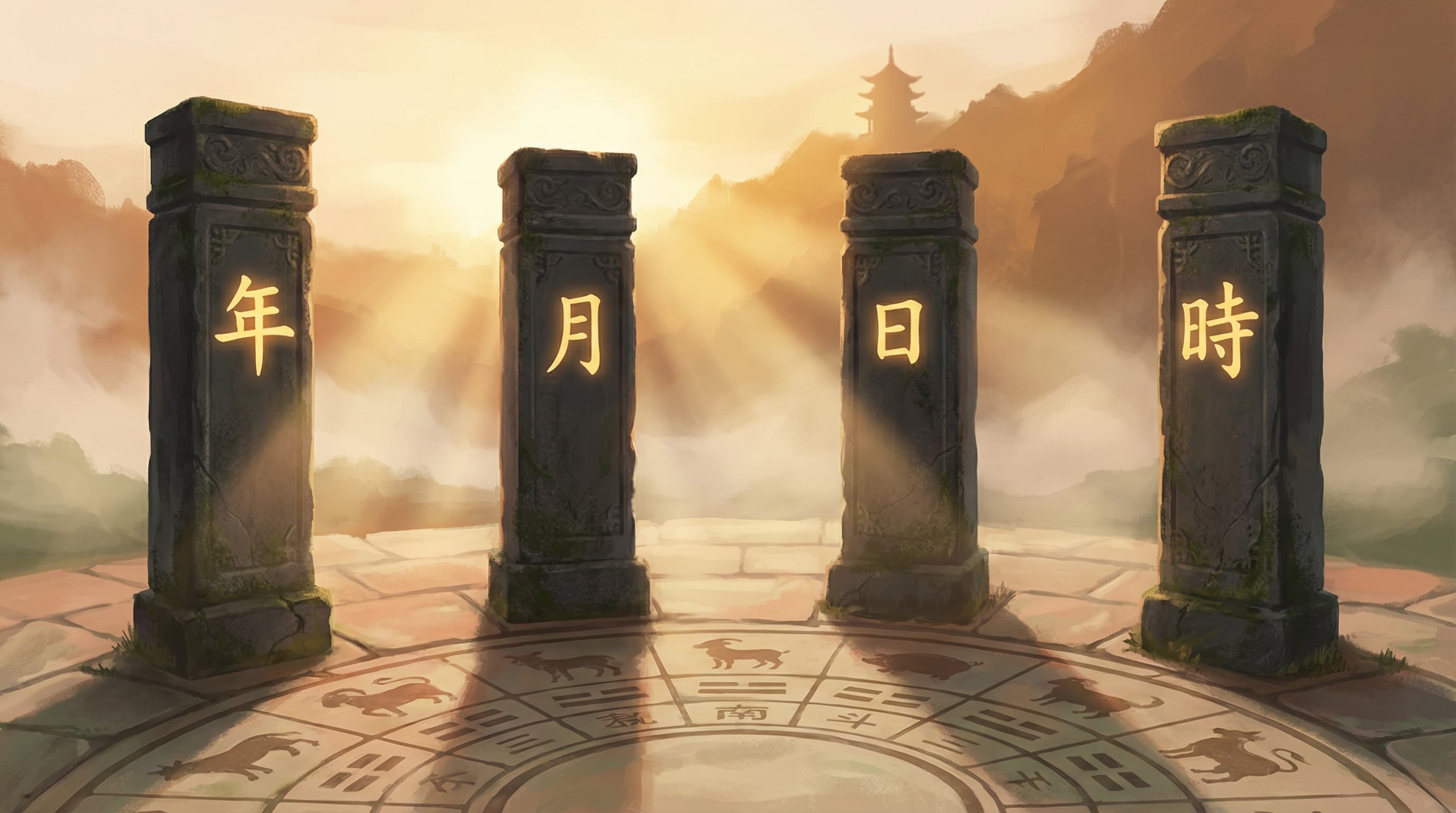
To read a Zi Wei Dou Shu chart, check the input, locate the Life Palace and Body Palace, separate the labels, read the star combination, check surrounding palaces and transformations, then separate natal facts from the active decadal. Begin with facts you can point to on the grid. A single star is not an outcome.
You can generate a chart first, or work through the complete fictional example below without an account or paid reading.
Contents
- Complete fictional chart
- Six-step reading sequence
- Worked career question
- Relationship and wealth checks
- Check an existing chart
- Common mistakes
Complete fictional chart and legend
The fictional teaching chart uses 15 June 1995, the Si hour (09:00–10:59), male, Asia/Taipei, local civil time, with no true-solar correction. The calculation representative is 10:30; the recorded precision is an hour block, not a verified minute. Its lunar date is the non-leap fifth month, day 18, in the Yi Hai year. These are synthetic test inputs, not a real person's record.
Engine: iztro@2.6.1; rules: ziwei-tianpan-lny-half-leap-forward-zi-v1; birth-year transformations: ziwei-default-ten-stems-v1; brightness: iztro-2.6.1-brightness-v1. This version uses lunar New Year as the Zi Wei year boundary, splits a leap month after day 15, and advances the full date for late Zi (23:00–23:59). Age is nominal, increasing at lunar New Year. At the frozen observation date 30 September 2026, Asia/Taipei, the nominal age is 32; the completed age is 31. The active natal-palace decadal is Spouse, ages 26–35, lunar years 2020–2029. A decadal is not an annual forecast.
The complete example has been checked against two reference charts, Windada and com9, under matched settings. Reproducing placement is a calculation check; it does not establish the validity of predictions.
Legend: cells 1–12 are fixed branch positions, starting at Yin and running around the perimeter. The palace name is a movable life-domain label. Main stars include their brightness ID; smaller following lines list auxiliary stars. lu, quan, ke, ji mark the four birth-year transformations. BODY is the Body marker, not another cell. Decadal numbers are nominal ages, not completed ages or calendar years. These neutral colors group information; they do not score luck.
The full-size grid is useful for orientation. On a phone, use these numbered text segments: they preserve every displayed main star, auxiliary star, transformation and decadal range without requiring you to read tiny labels.
Mobile segment 1–4
- 1. Parents (父母宮) · 戊寅 (
palace:parents): main Tan Lang (貪狼) (Neutral (平)); auxiliary Huo Xing (火星) (Temple (廟)); Tuo Luo (陀羅) (Fallen (陷)); transformations none; decadal nominal ages 116–125. - 2. Inner life (福德宮) · 己卯 (
palace:spirit): main Ju Men (巨門) (Temple (廟)); Tian Ji (天機) (Strong (旺)); auxiliary Ling Xing (鈴星) (Favorable (利)); Lu Cun (祿存); transformations Tian Ji (天機) Lu · resources (化祿); decadal nominal ages 106–115. - 3. Property (田宅宮) · 庚辰 (
palace:property): main Tian Xiang (天相) (Supported (得)); Zi Wei (紫微) (Supported (得)); auxiliary Di Jie (地劫); Qing Yang (擎羊) (Temple (廟)); transformations Zi Wei (紫微) Ke · recognition (化科); decadal nominal ages 96–105. - 4. Career (官祿宮) · 辛巳 (
palace:career): main Tian Liang (天梁) (Fallen (陷)); auxiliary Tian Ma (天馬); Wen Chang (文昌) (Temple (廟)); transformations Tian Liang (天梁) Quan · agency (化權); decadal nominal ages 86–95.
Mobile segment 5–8
- 5. Friends (交友宮) · 壬午 (
palace:friends): main Qi Sha (七殺) (Strong (旺)); auxiliary Di Kong (地空); You Bi (右弼); transformations none; decadal nominal ages 76–85. - 6. Travel (遷移宮) · 癸未 (
palace:travel): main no main star; auxiliary none; transformations none; decadal nominal ages 66–75. - 7. Health (疾厄宮) · 甲申 (
palace:health): main Lian Zhen (廉貞) (Temple (廟)); auxiliary Tian Yue (天鉞); Zuo Fu (左輔); transformations none; decadal nominal ages 56–65. - 8. Wealth (財帛宮) · 乙酉 (
palace:wealth): main no main star; auxiliary Wen Qu (文曲) (Temple (廟)); transformations none; decadal nominal ages 46–55.
Mobile segment 9–12
- 9. Children (子女宮) · 丙戌 (
palace:children): main Po Jun (破軍) (Strong (旺)); auxiliary none; transformations none; decadal nominal ages 36–45. - 10. Spouse (夫妻宮) · 丁亥 (
palace:spouse): main Tian Tong (天同) (Temple (廟)); auxiliary none; transformations none; decadal nominal ages 26–35; BODY / 身宫. - 11. Siblings (兄弟宮) · 戊子 (
palace:siblings): main Tian Fu (天府) (Temple (廟)); Wu Qu (武曲) (Strong (旺)); auxiliary Tian Kui (天魁); transformations none; decadal nominal ages 16–25. - 12. Life (命宮) · 己丑 (
palace:life): main Tai Yang (太陽) (Weak (不)); Tai Yin (太陰) (Temple (廟)); auxiliary none; transformations Tai Yin (太陰) Ji · friction (化忌); decadal nominal ages 6–15.
Six-step reading sequence
1. Check the source before the stars
Confirm solar versus lunar input, any leap month, time precision, time zone and effective time. Check the displayed year, late-Zi and age rules. For this example, the source is a Si-hour block, with no true-solar correction. Unknown minutes within a confirmed hour block are not the same as an unknown hour; do not promote either to exact-minute evidence.
2. Locate the Life Palace and Body Palace
Life is cell 12 at Chou: it contains Tai Yang and Tai Yin. Body is marked in cell 10, Spouse at Hai. Life supplies the self-positioning context; Body is an additional marker within the existing grid. Do not replace these with BaZi's separately calculated Life/Body values.
3. Separate palace name, branch and star
In cell 4, Career is the domain label, Si 巳 is the fixed branch, and Tian Liang is a star. Xin 辛 is the palace stem in the structured facts, not another star. The same branch can carry a different palace name in another chart. Consult the twelve-palace reference if the domain name is unfamiliar.
4. Read main stars, auxiliary stars and empty palaces
Career contains Tian Liang with Wen Chang and Tian Ma. Life has the two main stars Tai Yang and Tai Yin; interpret their interaction rather than adding two personality labels. Wealth has no main star but does contain Wen Qu. Travel has neither main nor listed auxiliary stars in this version. Neither is a blank life domain: inspect the opposite and related palaces while keeping their original positions. The fourteen-main-star reference distinguishes main stars from auxiliary names.
5. Read birth-year transformations and San Fang Si Zheng
The example's Yi-year transformations are Tian Ji Hua Lu in Inner life, Tian Liang Hua Quan in Career, Zi Wei Hua Ke in Property and Tai Yin Hua Ji in Life. Each transformation belongs to a specific star and palace; do not move Hua Lu onto a convenient “wealth star.” These are birth-year transformations, not flying transformations or annual changes.
For any target branch, walk four and eight branch positions to find its two trine positions, and six to find the opposite. Count around the fixed twelve-branch ring, not across arbitrary neighboring squares. Career at Si uses Wealth at You, Life at Chou and opposite Spouse at Hai. Together with Career, those are its San Fang Si Zheng. Their presence provides context, not a vote that guarantees an outcome.
6. Separate natal and current-decadal layers
Natal placements remain the chart's birth structure. At the frozen date 2026-09-30, the current decadal is Spouse, nominal ages 26–35. The career palace does not thereby acquire a new natal star. Record the date and age convention before saying “current.” This release does not provide flying-star, monthly or daily operations, and a ten-year decadal cannot be presented as a personal annual forecast.
Worked career question: negotiating responsibility
Question: “How can I discuss taking more responsibility while keeping my authority clear?” This is a question about work roles, not “Will I be promoted?”
Palaces: begin with Career at Si, then Wealth at You, Life at Chou and Spouse at Hai. The last of these is the opposite palace in this chart, not an arbitrary relationship detour.
Facts: palace:career contains star:tianliang, star:wenchang and star:tianma; sihua:quan applies to Tian Liang there. Life has Tai Yang/Tai Yin with Tai Yin Hua Ji. Wealth has Wen Qu but no main star. Spouse has Tian Tong and the Body marker.
Conditional interpretation: Tian Liang traditionally raises themes of experience, standards and guidance; Hua Quan adds an agency or responsibility theme. With Wen Chang, one useful reflection is how responsibilities are documented; Tian Ma makes changes in work setting another topic to check. Tai Yang/Tai Yin in Life keeps public contribution and private needs in view; neither brightness label ranks professional ability. You could prepare a written division of decisions, accountability and time commitment.
Limits: these are symbolic themes, not measured skills or employer intentions. The chart cannot establish a promotion, a suitable occupation or whether a proposed contract is fair. Check the actual role description, available support and decision rights. The active Spouse decadal does not manufacture annual Career facts.
Relationships and wealth: bounded checks
For relationships, palace:spouse has Tian Tong and the Body marker. Traditionally, that can prompt reflection on ease, care and the need to state boundaries. It does not describe an actual partner's personality or loyalty, and one person's chart is not compatibility. Use the surrounding Life and Inner life facts where relevant, and separate this natal reading from the current-decadal focus.
For wealth, palace:wealth has Wen Qu and no main star. Its opposite is Inner life at Mao, containing Tian Ji, Ju Men, Ling Xing and Lu Cun, with Tian Ji Hua Lu. Its trines are Life and Career. A bounded question is how planning, communication and work roles relate to resource management. The chart supplies no income amount, budget, debt balance or investment return. “No main star” does not mean “no money.”
How to check a chart you already have
- Match the original source, calendar and selected effective time, including whether a correction was applied.
- Match the lunar date, leap rule, year boundary and late-Zi rule before comparing stars.
- Check Life and Body branches and the five-elements class.
- Check all fourteen main stars by palace, then listed auxiliary stars and four birth-year transformations.
- Compare brightness only when the same table version is used.
- Compare decadal start/end ages, direction, age convention and the frozen observation date.
If software differs, locate the first factual mismatch. Different rules are a reason to inspect a calculation, not to choose whichever interpretation sounds more flattering. Copy structured text with version fields and fact IDs; remove private input fields before sending it elsewhere. The AI prompt guide provides three complete prompts that forbid filling missing facts.
Common mistakes
An empty palace means no main star in that cell, not an absent life area. Two main stars form a combination in one palace; they are not two independent test results. Brightness names such as Temple, Strong or Fallen are versioned traditional labels, not success scores. BaZi Life/Body terminology is a different calculation. Nominal age increases at lunar New Year; completed age increases at a birthday. Finally, a natal chart and a decadal are different layers: neither licenses an invented annual, monthly or daily forecast.
Once you can cite one question's facts and limits, return to your chart. For another system's perspective, use the worked BaZi comparison.
Frequently asked questions
Where should I start reading?
Check input and rules, then find Life and Body. Separate the palace, branch and star labels before reading a combination, transformations and the active decadal.
Does an empty palace have no meaning?
No. It has no main star, and may still contain auxiliary stars. Read its domain with its opposite and trine palaces without moving those stars into the empty cell.
Do two main stars mean two personalities?
No. Read their combination within one palace, with co-located stars and transformations. Do not add two fixed labels.
Do colors or brightness score my luck?
No. Colors organize the diagram, while brightness names belong to a specific traditional table. Neither is a measured outcome score.
Why is the example age 32 rather than 31?
At 2026-09-30 it uses nominal age, increasing at lunar New Year. Its completed age is 31. Use the displayed age convention when checking decadals.
Is the current decadal an annual forecast?
No. A ten-year decadal and an annual layer are different. This example supplies natal placements and a frozen current decadal, not annual, monthly or daily charts.
Is the Body Palace a thirteenth palace?
No. Body is a marker in one existing palace. Here it is in Spouse at Hai.
Do I need to buy a reading to finish this guide?
No. The complete example, reading sequence and references are publicly readable. The planned AI deep reading is separate and is not yet open for purchase.
Author
Categories
More Posts

BaZi Bone Weight Fortune: How It Works and What It Means
How BaZi bone weight is calculated, what the 2.1-7.2 liang score indexes, why table versions differ, and how to read the traditional poems without treating them as predictions.

What Does Hong Yan Sha Mean? BaZi Lookup & Love Myths
What does Hong Yan Sha (Red Beauty Star) mean in BaZi? See the Day Stem lookup, school differences, and why it does not prove attraction or bad romance.

AI Zi Wei Dou Shu prompts: facts, examples and answer checks
Generate, check and copy a chart before asking AI. Three complete prompts explain one domain, single-person relationships and BaZi comparison with evidence and limits.
Newsletter
Join the community
Subscribe to our newsletter for the latest news and updates