Zi Wei Dou Shu fourteen main stars: names, groups and reading limits
All fourteen main stars with stable IDs, Chinese and Japanese names, placement groups, palace-based examples and limits, plus brightness and transformation labels.
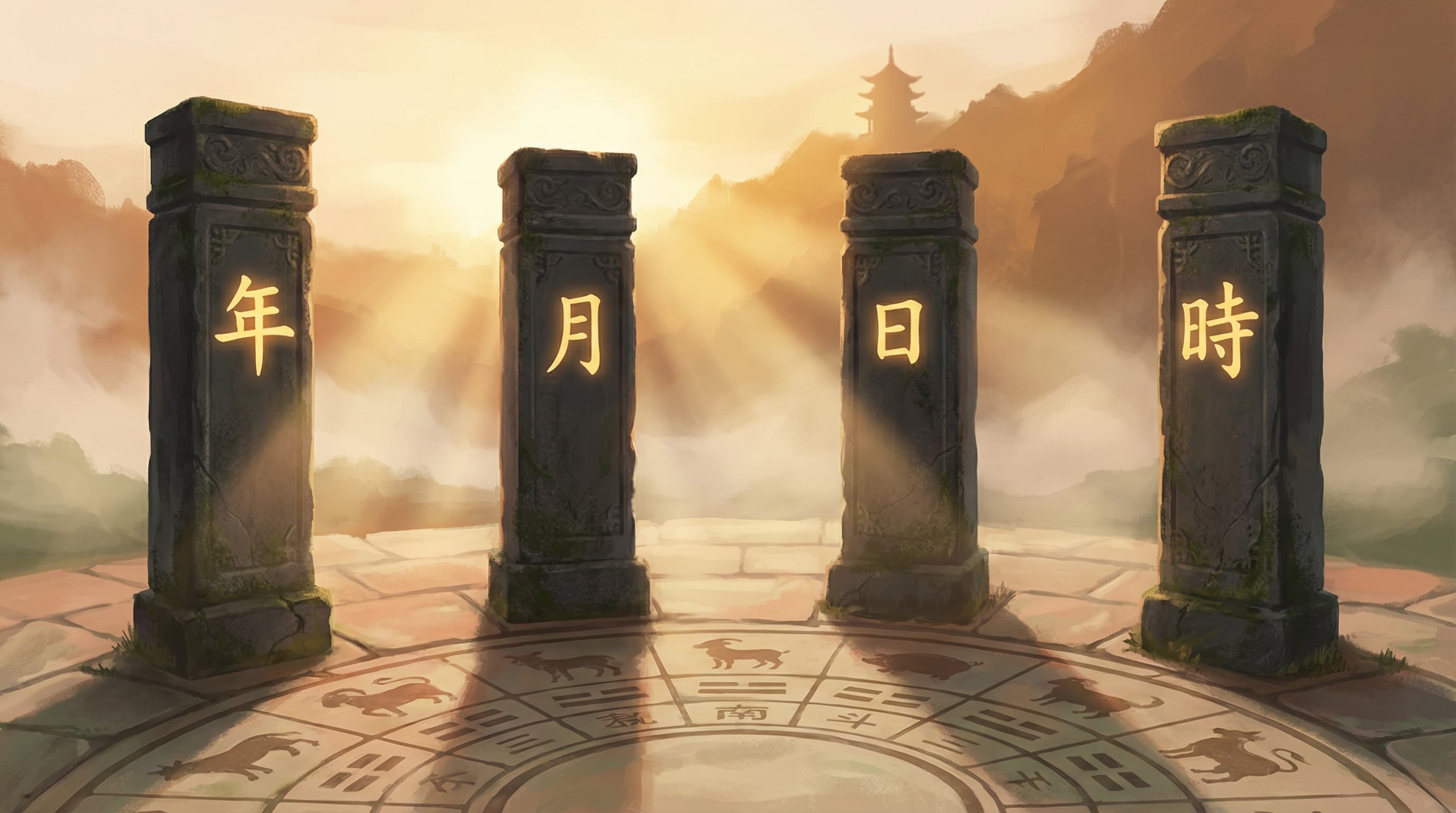
Zi Wei Dou Shu has fourteen main stars, organized here into the six-star Zi Wei placement group and eight-star Tian Fu placement group. A main star is a traditional symbolic reference inside a palace, not a standalone personality test or an inevitable career.
Use the Zi Wei tool to locate your stars. This page is a complete reference for the names you have already seen, while the reading guide teaches the full-chart sequence.
Names, stable IDs and directory
| ID / anchor | 简体 | 繁體 | English / Pinyin | 日本語 | Placement group |
|---|---|---|---|---|---|
| ziwei | 紫微 | 紫微 | Zi Wei | 紫微 | Zi Wei six / 紫微六星 |
| tianji | 天机 | 天機 | Tian Ji | 天機 | Zi Wei six / 紫微六星 |
| taiyang | 太阳 | 太陽 | Tai Yang | 太陽 | Zi Wei six / 紫微六星 |
| wuqu | 武曲 | 武曲 | Wu Qu | 武曲 | Zi Wei six / 紫微六星 |
| tiantong | 天同 | 天同 | Tian Tong | 天同 | Zi Wei six / 紫微六星 |
| lianzhen | 廉贞 | 廉貞 | Lian Zhen | 廉貞 | Zi Wei six / 紫微六星 |
| tianfu | 天府 | 天府 | Tian Fu | 天府 | Tian Fu eight / 天府八星 |
| taiyin | 太阴 | 太陰 | Tai Yin | 太陰 | Tian Fu eight / 天府八星 |
| tanlang | 贪狼 | 貪狼 | Tan Lang | 貪狼 | Tian Fu eight / 天府八星 |
| jumen | 巨门 | 巨門 | Ju Men | 巨門 | Tian Fu eight / 天府八星 |
| tianxiang | 天相 | 天相 | Tian Xiang | 天相 | Tian Fu eight / 天府八星 |
| tianliang | 天梁 | 天梁 | Tian Liang | 天梁 | Tian Fu eight / 天府八星 |
| qisha | 七杀 | 七殺 | Qi Sha | 七殺 | Tian Fu eight / 天府八星 |
| pojun | 破军 | 破軍 | Po Jun | 破軍 | Tian Fu eight / 天府八星 |
Why six plus eight, not six plus six
This is a placement classification, following the two arrays in iztro v2.6.1’s main-star source. The Zi Wei group contains Zi Wei, Tian Ji, Tai Yang, Wu Qu, Tian Tong and Lian Zhen; the Tian Fu group contains Tian Fu, Tai Yin, Tan Lang, Ju Men, Tian Xiang, Tian Liang, Qi Sha and Po Jun. Blank slots in the placement arrays are offsets, not missing stars. Other schools may group stars by interpretive qualities; those labels are not interchangeable with these two placement groups.
Wen Chang, Wen Qu, Zuo Fu and You Bi are examples of auxiliary stars in this tool, not extra main stars. A transformation can apply to an auxiliary star under the selected year-stem table; that does not promote it into the fourteen-star list. These terms follow the tool glossary.
Every main star: symbol, palace context and limits
The following are traditional themes for reflection, not observations about a real person. Each example uses the same calculated fictional chart in the reading guide: 1995-06-15, Si hour, male, Asia/Taipei, local civil time, no true-solar correction. Its rule version is ziwei-tianpan-lny-half-leap-forward-zi-v1; transformation and brightness versions are ziwei-default-ten-stems-v1 and iztro-2.6.1-brightness-v1.
Zi Wei (紫微)
Traditional symbolism: coordination, responsibility and leadership.
Back in a palace: In Property, ask who coordinates household arrangements rather than declaring a born leader.
Read together: Here it shares Property with Tian Xiang, has Hua Ke, and must be read with Di Jie, Qing Yang and opposite Children.
Limit: It cannot establish status, wealth or property ownership.
Tian Ji (天機)
Traditional symbolism: planning, thought and adaptation.
Back in a palace: In Inner life, ask how planning and rest are balanced rather than treating it as an intelligence test.
Read together: Here it shares Inner life with Ju Men, Ling Xing and Lu Cun, has Hua Lu, and faces Wealth with Wen Qu.
Limit: It does not guarantee intelligence, a skill or profit in a given year.
Tai Yang (太陽)
Traditional symbolism: visibility, service and contribution.
Back in a palace: In Life, discuss public involvement and available effort without assigning an extroverted personality.
Read together: Here it shares Life with Tai Yin; Tai Yang is bu, while Tai Yin is miao and has Hua Ji. Read the pair.
Limit: Its brightness does not score social achievement or prescribe gender roles.
Wu Qu (武曲)
Traditional symbolism: execution, discipline and resource management.
Back in a palace: In Siblings, consider division of practical support rather than jumping to earning ability.
Read together: Here it shares Siblings with Tian Fu and Tian Kui and is wang; check opposite Friends and relevant surrounding facts.
Limit: A traditional wealth-star label does not promise income or prescribe finance as a career.
Tian Tong (天同)
Traditional symbolism: harmony, comfort and responsiveness.
Back in a palace: In Spouse, ask how comfort and boundaries are communicated rather than describing the actual partner.
Read together: Here Tian Tong is miao and Body marks the same palace; check opposite Career and transformations, keeping natal and decadal layers separate.
Limit: It does not guarantee popularity, a happy marriage or freedom from pressure.
Lian Zhen (廉貞)
Traditional symbolism: principles, boundaries and commitment.
Back in a palace: In Health, use it only for reflection on workload and rest, not as a disease indication.
Read together: Here it is miao with Zuo Fu and Tian Yue; preserve that palace context without making medical claims.
Limit: It cannot diagnose illness or establish fidelity.
Tian Fu (天府)
Traditional symbolism: stewardship, stability and consolidation.
Back in a palace: In Siblings, discuss support and continuity rather than judging a sibling’s wealth.
Read together: Here it is miao with Wu Qu and Tian Kui; include opposite Friends with Qi Sha and auxiliary stars.
Limit: Stability symbolism does not establish another person’s reliability or savings.
Tai Yin (太陰)
Traditional symbolism: detail, care and private feelings.
Back in a palace: In Life, ask how unspoken needs are expressed without assigning a sensitive or introverted personality.
Read together: Here it shares Life with Tai Yang and is miao with Hua Ji; keep both labels rather than canceling them.
Limit: Miao with Hua Ji is not a verdict of good or bad, and is not a mental-health diagnosis.
Tan Lang (貪狼)
Traditional symbolism: exploration, sociability and varied interests.
Back in a palace: In Parents, consider interaction with authority and needs rather than a count of romantic relationships.
Read together: Here it is ping with Huo Xing and Tuo Luo; check co-located stars, transformations and opposite-palace facts.
Limit: Many interests do not establish infidelity or the actual character of parents.
Ju Men (巨門)
Traditional symbolism: analysis, questioning and speech.
Back in a palace: In Inner life, ask how doubts are processed rather than declaring an argumentative person.
Read together: Here it shares Inner life with Tian Ji, Ling Xing and Lu Cun; Hua Lu belongs to Tian Ji, not Ju Men.
Limit: It cannot predict disputes or litigation or provide a legal conclusion.
Tian Xiang (天相)
Traditional symbolism: cooperation, fairness and mediation.
Back in a palace: In Property, discuss balance in household roles rather than property valuation.
Read together: Here it shares Property with Zi Wei, Di Jie and Qing Yang; Hua Ke belongs to Zi Wei and must not be moved to Tian Xiang.
Limit: It cannot guarantee a dependable partner or a fair relationship.
Tian Liang (天梁)
Traditional symbolism: protection, experience and standards.
Back in a palace: In Career, ask how experience informs work rather than prescribing medicine or teaching.
Read together: Here it is xian with Hua Quan and co-located Wen Chang/Tian Ma; check Life, Wealth and Spouse around Career.
Limit: Protection symbolism does not guarantee safety, and xian does not establish career failure.
Qi Sha (七殺)
Traditional symbolism: decisiveness, independence and pressure.
Back in a palace: In Friends, discuss autonomy in cooperation rather than labeling friends as dangerous.
Read together: Here it is wang with Di Kong and You Bi; check opposite Siblings with Wu Qu and Tian Fu.
Limit: The character 殺 does not justify predicting calamity or another person’s hostility.
Po Jun (破軍)
Traditional symbolism: restructuring, renewal and replacement.
Back in a palace: In Children, ask how care or creativity accommodates change rather than predicting family events.
Read together: Here it is wang, opposite Property’s Zi Wei/Tian Xiang and Zi Wei Hua Ke; those stars remain in Property.
Limit: The name does not establish bankruptcy, separation or a fertility outcome.
Two fictional combinations, read without adding labels
Tai Yang + Tai Yin in Life at Chou: the facts are Tai Yang [bu], Tai Yin [miao] and Tai Yin Hua Ji. Public contribution and private needs can become a reflection question; they do not prove “half extrovert, half introvert.” Hua Ji and brightness belong to different layers; one does not cancel the other. Check the opposite Travel and the Life trines Career/Wealth before extending the interpretation.
Zi Wei + Tian Xiang in Property at Chen: the facts are both stars [de], Zi Wei Hua Ke, and co-located Di Jie/Qing Yang. Coordination and fairness can raise a question about household roles. This does not mean two leadership labels guarantee a large home, or that an auxiliary name predicts a loss. Check opposite Children with Po Jun while retaining all stars in their actual palaces.
The example’s Wealth Palace has no main star but does contain Wen Qu. Read it with opposite Inner life’s Tian Ji/Ju Men and the other surrounding palaces; do not insert those stars into Wealth. Empty is a placement condition, not “no life” or a missing personality. The complete chart supplies the full context for both combinations and the empty palace.
Brightness and birth-year transformations are separate layers
Brightness names are 廟 miao (Temple), 旺 wang (Strong), 得 de (Supported), 利 li (Favorable), 平 ping (Neutral), 不 bu (Weak) and 陷 xian (Fallen), following the tool glossary and pinned table. A brightness label depends on star and branch in the selected table; it is not an outcome probability. The versioned star data shows why the table identity matters. Some auxiliary stars have no brightness entry in this tool; do not invent one.
Lu 化祿, Quan 化權, Ke 化科 and Ji 化忌 are the four birth-year transformations in this release. Identify the actual star and palace named by the facts. In the fictional Yi-year chart, Tian Ji has Lu, Tian Liang has Quan, Zi Wei has Ke and Tai Yin has Ji. These labels add context; they are not four new stars or annual changes. This reference does not teach flying-star operations or create separate star-by-palace-by-transformation pages.
Use the twelve palaces for location context, the reading guide for sequence, and the tool to locate your own main stars. If asking AI, require its claims to cite supplied facts using the prompt guide.
Frequently asked questions
Are there fourteen or sixteen main stars?
This tool’s main-star list has fourteen: six in the Zi Wei placement group and eight in Tian Fu. Auxiliary stars are a separate list.
Can my main star determine my personality or career?
No. Read the traditional theme in its palace with co-located stars, transformations and surrounding-palace facts. It is not a personality test or a profession assignment.
Is an empty Life Palace a missing personality?
No. It means no main star in that cell. Read auxiliary stars and related palaces without inventing or relocating a main star.
Do two stars mean two scores added together?
No. The stars share one palace context and must be read as a combination, with the supplied transformation and auxiliary facts.
Does Hua Ji override a miao brightness label?
No. Brightness and birth-year transformation are separate layers. Keep both facts and their versions; neither is a guaranteed outcome.
Is Qi Sha a prediction of danger?
No. A star name does not establish a calamity or anyone’s intent. In this reference Qi Sha is a traditional theme of decisiveness, independence and pressure.
Where can I see my own main stars?
Generate a chart in the Zi Wei tool with a confirmed birth hour, then inspect each palace’s main-star list and fact text.
Author
Categories
More Posts
Seven Killings in BaZi: Meaning, Traits & Eating God Pattern
Seven Killings in BaZi explained: personality traits, career pressure, relationship patterns, and the Eating God Controls Killings structure.

BaZi Career Guide: Find Work That Fits Your Chart
Use this bazi career guide to match your favorable element and Ten Gods to the right industry, role, and timing. Practical career advice from Chinese astrology.
Zi Wei Dou Shu 12 palaces: names, meanings and chart relationships
All twelve palaces with Chinese, Pinyin, English and Japanese names, a complete diagram, fictional examples and limits, including opposite and trine positions.
Newsletter
Join the community
Subscribe to our newsletter for the latest news and updates