27 Personality Types Test: Free Quiz Based on Chinese Astrology (BaZi)
Free personality test with 27 unique types — take 31 quick questions or enter your birthday for a BaZi-based reading. No signup. Find your type in 3 minutes.
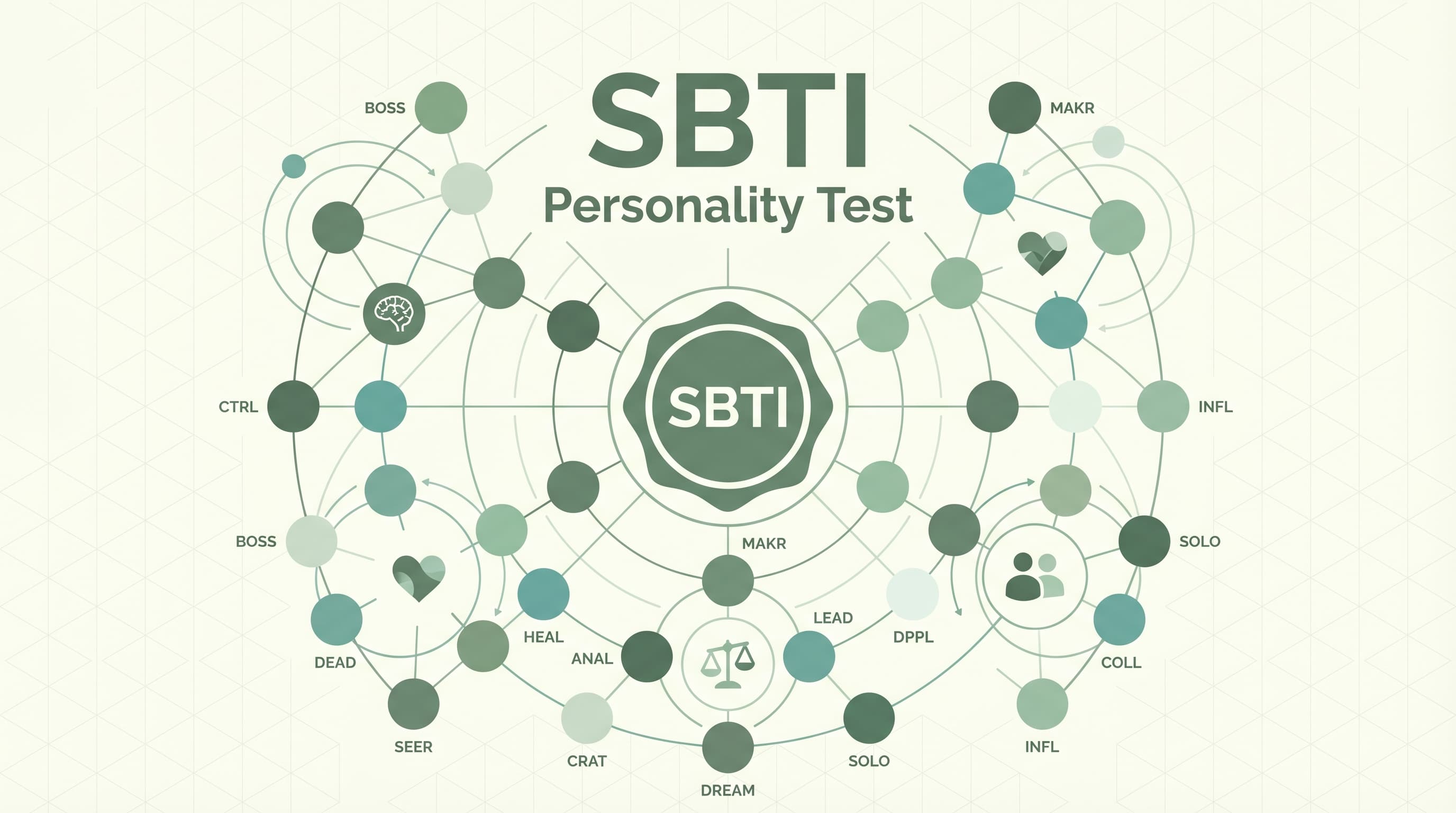
What Is the SBTI Personality Test?
GuanXiang's SBTI personality test offers a question-based quiz and a BaZi-based mode for entertainment. Results show a type code, a name, a description, and a dimension profile. Use them as prompts for comparing everyday habits or talking with friends.
If your result says OG8K, MUM, or THAN-K, the tables below list the names used in the current product. The catalog contains 25 standard types and 2 special results: 27 in total. These are defined templates, not every possible combination of three letters, and the result is not a validated psychological diagnosis.
Try the free SBTI test, or compare the two modes first.
Choose Between the Quiz and BaZi Modes
| Mode | What you provide | How the result is produced |
|---|---|---|
| Quiz | Answers about everyday behavior | Answers form 15 dimensions, which are compared with type templates |
| BaZi mode | Birth date, a confirmed birth time, sex, and birth region | Calculated Ten Gods distributions are mapped to 15 dimensions using product rules, then compared with the same templates |
The quiz describes the choices you make in this attempt. BaZi mode is a rule-based interpretation of traditional chart data; it does not establish that birth data measures psychological traits. The two modes can return different results. Those differences can be interesting questions to explore without deciding that one label defines you.
31 Questions, 15 Dimensions, and 5 Groups
There are 30 ordinary scoring questions, with 2 questions for each dimension. An additional lighthearted hobby question brings the usual sequence to 31. A particular hobby choice opens a follow-up question. Question order varies, and completion time depends on how much time you take to read and reflect.
The 15 dimensions are organized into 5 groups:
| Group | Dimensions |
|---|---|
| Self model | Self-esteem and confidence, self-clarity, core values |
| Emotion model | Attachment security, emotional investment, boundaries and dependence |
| Attitude model | Worldview, rules and flexibility, sense of meaning |
| Action drive model | Motivation, decision style, execution |
| Social model | Social initiative, interpersonal boundaries, expression and authenticity |
Each dimension becomes an L, M, or H level. Matching uses all 15 dimensions. The calculation 3 × 3 × 3 does not explain this system: 27 is the size of its current result catalog.
All 27 SBTI Result Codes
25 Standard Types
These playful names are the labels used in the test. They are not judgments of a person's worth or permanent identity.
| Code | Result name |
|---|---|
CTRL | Controller |
ATM-er | Giver |
Dior-s | Realist Sage |
BOSS | Leader |
THAN-K | Grateful One |
OH-NO | Worrier |
GOGO | Go-Getter |
SEXY | Charmer |
LOVE-R | Romantic |
MUM | Nurturer |
FAKE | Chameleon |
OG8K | Whateverist |
MALO | Mischief Maker |
JOKE-R | Joker |
WOC! | Shock Sage |
THIN-K | Thinker |
SHIT | Rager |
ZZZZ | Sleeper |
POOR | Focused Minimalist |
MONK | Monk |
IMSB | Inner Duelist |
SOLO | Lone Guard |
FU?K | Wild Grass |
DEAD | Dead Battery |
IMFW | Soft Core |
2 Special Results
| Code | Result name |
|---|---|
HHHH | Laugher |
DRUNK | Drunk |
HHHH is the fallback when the closest standard template has a similarity below 60%. DRUNK is activated by a specific answer in the quiz's optional hobby branch; it is not a professional assessment of alcohol use. A special result may also show the closest standard match.
What Does the Match Percentage Mean?
Standard matching represents L, M, and H as 1, 2, and 3. It adds the differences between your levels and a template across the 15 dimensions, then calculates:
similarity = max(0, round((1 - total distance / 30) × 100))
A result such as 83% describes closeness to a product template. It is not an accuracy rate or the share of people with that personality. Without a population study, there is no basis to claim the 27 results are evenly distributed. The secondary match and individual dimensions can offer more context than a code alone.
How Ten Gods Enter BaZi Mode
BaZi mode uses the relative rankings of five Ten Gods groups: Companions, Output, Wealth, Officer/Seven Killings, and Resource. Different combinations contribute to the 15 dimensions; each group does not simply own one dimension.
For example, the self-confidence rule combines Companion, Resource, and Officer/Seven Killings rankings. Other dimensions use their own combinations. The resulting L/M/H levels go through the same type catalog as the quiz. This mapping has not been shown to be more objective than answering questions.
The same valid birth inputs and algorithm version produce the same rule-based result. Correcting birth details or changing the algorithm can change that result. To inspect the source chart, use the free BaZi calculator; see the Ten Gods guide for terminology.
Take the Test and Read Your Result
- Open the SBTI test and choose the quiz or BaZi mode.
- In the quiz, answer according to your current experience and use the previous-question control to make changes. In BaZi mode, enter birth details and review the chart before continuing.
- Read the code, name, description, dimensions, and other matches. Codes can contain letters, numbers, or punctuation; they are not restricted to three letters.
- Use the result page's image-sharing option or start another attempt. Review any image before sharing personal information.
Both SBTI modes are free to use without registering. Tool links in this guide follow the current page language.
Frequently Asked Questions
Can SBTI and MBTI codes be converted into each other?
Do not treat their codes as interchangeable. This guide describes the SBTI implementation on this site, with its own questions, dimensions, and templates. Consider what a test asks, how it calculates a result, and whether that serves your purpose.
Which languages are supported?
The current test supports English, Simplified Chinese, Traditional Chinese, and Japanese. Type codes stay consistent while names and descriptions are localized.
Why can a result change?
Different quiz answers can change the dimension profile and closest match. In BaZi mode, check that the birth details, timezone, and calculation rules remain the same. Either way, a label does not require you to accept a fixed description of yourself.
What if I do not know my birth time?
Choose the quiz, which does not need birth details. Unknown-hour candidates in the birth form show possibilities for verification; a default noon value should not be treated as a recorded birth time for a complete result.
Take the free SBTI test · Inspect a BaZi chart · Explore Bone Weight
🔮 Curious about your BaZi chart?
Get your free Four Pillars chart, Five Elements and Ten Gods. Explore optional AI reports and review the cost before generating.
Author
Categories
More Posts
The 12 Palaces of Zi Wei Dou Shu: What Each Palace Means
From the Life Palace to the Parents Palace, what does each of the twelve palaces in Zi Wei Dou Shu (Purple Star Astrology) cover? Plain-English meanings, alternative names and how related palaces work, with an interactive example chart.
How to Read a BaZi Chart: A Practical Beginner's Guide
Learn how to read a BaZi chart step by step, from Ten Heavenly Stems and Twelve Earthly Branches to Day Master strength, Ten Gods, and luck pillars.
BaZi Weight Chart: Full Bone Weight Lookup Tables
Complete BaZi weight chart with sexagenary year, lunar month, lunar day, and birth-hour lookup tables, a verified example, and version notes.
Newsletter
Get new guides by email
New articles on BaZi, compatibility and Zi Wei Dou Shu, plus product updates, sent to your inbox.