How to Calculate a BaZi Chart by Hand: Year, Month, Day and Hour Pillars
Each of the four pillars follows its own rule: the year changes at Li Chun, the month at a solar term, the day on a sixty-day cycle, and the hour every two hours. This guide gives the lookup formulas and a worked example for every pillar, then covers the four places people go wrong: exact solar-term times, daylight saving, true solar time and the 23:00 hour. Check your result in the free calculator.
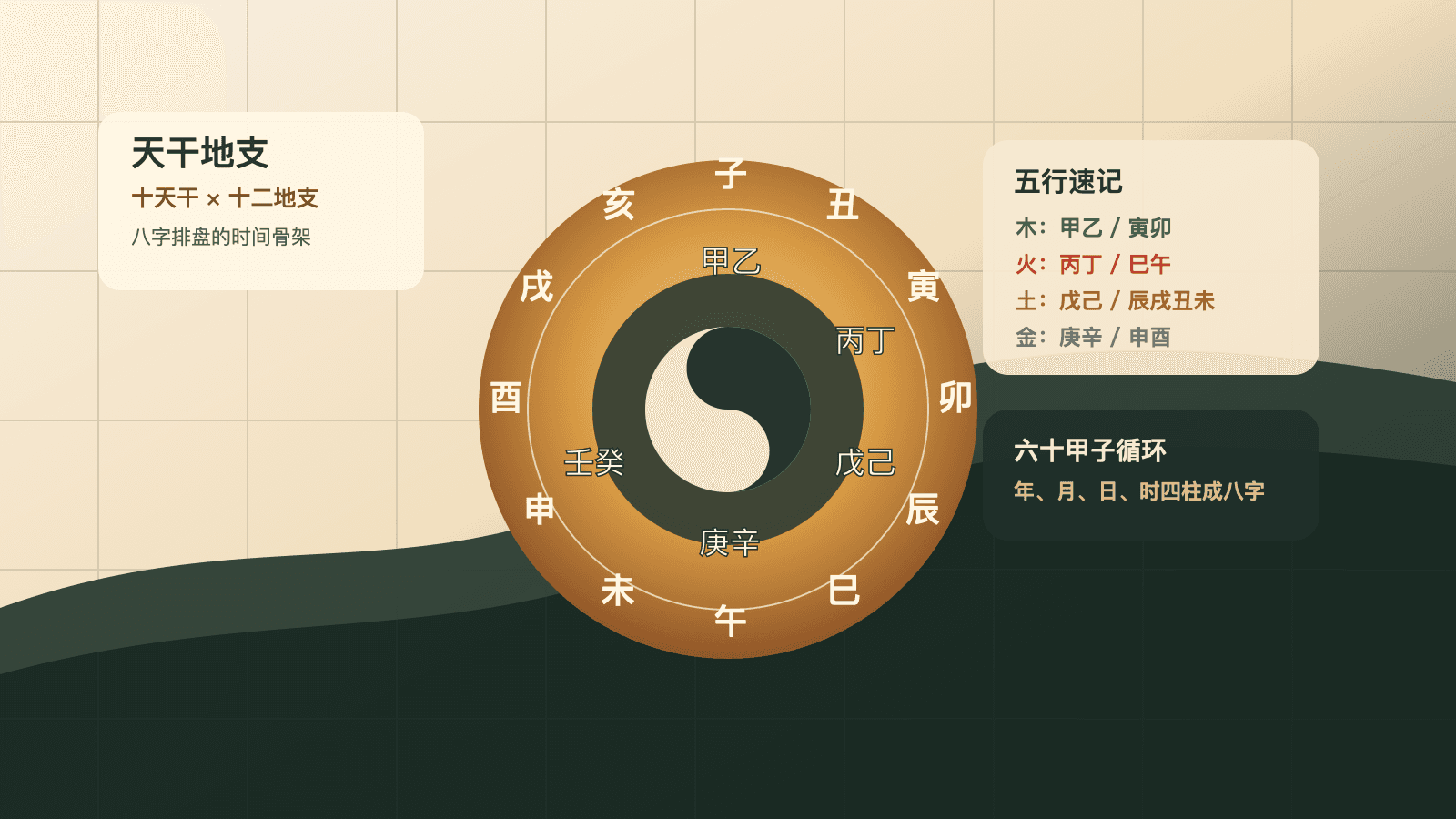
The four pillars of a BaZi chart each follow a different rule: the year pillar turns at Li Chun, the month pillar at a solar-term boundary, the day pillar on a sixty-day cycle, and the hour pillar every two hours. Once you know the rules you can work a chart by hand, and the free calculator will check it in seconds. One warning up front: if you were born close to a solar-term boundary, compare the boundary's exact time in your birthplace's local time before you trust the year and month pillars.
We will use one fictional example throughout: 12 April 1988 at 10:00 in Taipei. The answer is Wu-Chen, Bing-Chen, Ding-You, Yi-Si.
Preparation: numbering the sixty pairs
A stem-branch pair combines one of the ten Heavenly Stems (Jia, Yi, Bing, Ding, Wu, Ji, Geng, Xin, Ren, Gui) with one of the twelve Earthly Branches (Zi, Chou, Yin, Mao, Chen, Si, Wu, Wei, Shen, You, Xu, Hai) in order, giving sixty pairs before the cycle repeats. Number Jia-Zi as 1; then 11 is Jia-Xu, 21 Jia-Shen, 31 Jia-Wu, 41 Jia-Chen, 51 Jia-Yin and 60 Gui-Hai.
To turn a number back into a pair:
- Stem: the remainder when the number is divided by 10 (1 is Jia, 2 is Yi … 0 is Gui)
- Branch: the remainder when divided by 12 (1 is Zi, 2 is Chou … 0 is Hai)
The full table of sixty pairs and what each means is in the Heavenly Stems and Earthly Branches guide.
Year pillar: the year turns at Li Chun
In BaZi the year does not begin on 1 January or at Lunar New Year but at Li Chun, the Beginning of Spring, around 4 February. Anyone born before Li Chun belongs to the previous year's pair.
From the Western year:
- Stem: the remainder of (year − 3) divided by 10
- Branch: the remainder of (year − 3) divided by 12
For 1988: 1988 − 3 = 1985. Divided by 10 the remainder is 5, Wu; divided by 12 it is 5, Chen. The year pillar is Wu-Chen.
But someone born at noon on 4 February 1988 was still ahead of that year's Li Chun (which fell on the evening of 4 February), so their year pillar is the previous Ding-Mao. Li Chun 2026 falls at 04:02 on 4 February Taipei time (20:02 UTC on 3 February): births before it belong to the Yi-Si year, births after it to Bing-Wu. If you were born in January or early February, always look up the exact date and time of Li Chun.
Month pillar: the month turns at a solar term
The BaZi month does not start on the first of a calendar month but at the "节" boundaries, twelve of the twenty-four solar terms.
| Month branch | Starting term | Approximate date |
|---|---|---|
| Yin | Li Chun (Beginning of Spring) | 4 Feb |
| Mao | Jing Zhe (Awakening of Insects) | 6 Mar |
| Chen | Qing Ming (Clear and Bright) | 5 Apr |
| Si | Li Xia (Beginning of Summer) | 6 May |
| Wu | Mang Zhong (Grain in Ear) | 6 Jun |
| Wei | Xiao Shu (Minor Heat) | 7 Jul |
| Shen | Li Qiu (Beginning of Autumn) | 8 Aug |
| You | Bai Lu (White Dew) | 8 Sep |
| Xu | Han Lu (Cold Dew) | 8 Oct |
| Hai | Li Dong (Beginning of Winter) | 7 Nov |
| Zi | Da Xue (Major Snow) | 7 Dec |
| Chou | Xiao Han (Minor Cold) | 6 Jan |
The month stem depends on the year stem, which fixes the pair for the Yin month; the rest follow in order. The rule is called the Five Tigers.
| Year stem | Yin-month pair |
|---|---|
| Jia, Ji | Bing-Yin |
| Yi, Geng | Wu-Yin |
| Bing, Xin | Geng-Yin |
| Ding, Ren | Ren-Yin |
| Wu, Gui | Jia-Yin |
1988 is a Wu year, so the Yin month is Jia-Yin, Mao is Yi-Mao and Chen is Bing-Chen. 12 April is past Qing Ming (21:39 on 4 April in 1988), so it is a Chen month and the month pillar is Bing-Chen. A birth at noon on 4 April would still be in the Mao month, Yi-Mao.
Day pillar: a sixty-day cycle
The day's pair is independent of month and year: the same pair returns every sixty days. Knowing one reference date is enough to count to any other.
Reference: 1 January 2000 was a Wu-Wu day (number 55).
Day number = the remainder of (55 + days since the reference) divided by 60 (a remainder of 0 counts as 60)
24 October 2026 is 9,793 days after 1 January 2000. 55 + 9,793 = 9,848; divided by 60 the remainder is 8, so the day pillar is Xin-Wei.
For dates before the reference, count the days as negative. 12 April 1988 is 4,281 days before 1 January 2000: 55 − 4,281 = −4,226. Add multiples of 60 until the number is positive and you get 34, so the day pillar is Ding-You.
Day counts are easy to get wrong, so this is the step to hand to a spreadsheet or the calculator.
Hour pillar: the two-hour period and the day stem
The hour branch divides the day into twelve two-hour periods.
| Branch | Clock time | Branch | Clock time |
|---|---|---|---|
| Zi | 23:00–00:59 | Wu | 11:00–12:59 |
| Chou | 01:00–02:59 | Wei | 13:00–14:59 |
| Yin | 03:00–04:59 | Shen | 15:00–16:59 |
| Mao | 05:00–06:59 | You | 17:00–18:59 |
| Chen | 07:00–08:59 | Xu | 19:00–20:59 |
| Si | 09:00–10:59 | Hai | 21:00–22:59 |
The hour stem depends on the day stem, which fixes the pair for the Zi hour. The rule is called the Five Rats.
| Day stem | Zi-hour pair |
|---|---|
| Jia, Ji | Jia-Zi |
| Yi, Geng | Bing-Zi |
| Bing, Xin | Wu-Zi |
| Ding, Ren | Geng-Zi |
| Wu, Gui | Ren-Zi |
Our example has a Ding day stem, so the Zi hour is Geng-Zi, Chou is Xin-Chou, Yin is Ren-Yin, Mao is Gui-Mao, Chen is Jia-Chen and Si is Yi-Si. 10:00 falls in the Si hour, so the hour pillar is Yi-Si.
The chart is complete: Wu-Chen, Bing-Chen, Ding-You, Yi-Si. If you only need the four pairs and the birth double-hour quickly, the Stems and Branches calculator does just that.
The four places people go wrong
1. The exact time of the solar term
Li Chun and Qing Ming have a time of day, not just a date. For a birth on the boundary day, whether the birth time falls before or after the boundary changes the year or month pillar.
2. Local time versus true solar time
Clock time is tied to a standard meridian, but the sun's actual position shifts by about four minutes per degree of longitude. Taipei, at roughly 121.5°E against a 120°E standard, runs about six minutes ahead of its clock, and the equation of time adds up to a quarter hour either way across the year. Some schools correct for this "true solar time" when fixing the hour pillar. It only matters if your birth time sits near a two-hour boundary (the odd clock hours), and it matters most for places far from their time zone's standard meridian.
3. Daylight saving time
Many places have used daylight saving at some point: the United States and Europe still do, Taiwan did between 1945 and 1979, and mainland China did from 1986 to 1991. If the time on your birth record was daylight time, subtract an hour to get standard time before working by hand. With a calculator, check whether it already makes this correction so you do not apply it twice.
4. Births in the 23:00 hour
For births between 23:00 and midnight, schools differ on whether the day pillar belongs to that day or the next: one changes the day at 23:00, the other at 00:00. If this is you, cast both versions and compare; the Zi hour guide explains the two conventions.
Checking with the calculator
Once you understand the manual steps, it is still worth confirming the result with a tool. GuanXiang's BaZi calculator takes your birth date, time and place, casts the four pillars, and shows any time correction it applied. If you were born on or near a solar-term boundary, re-check the year and month pillars with the steps above and you can trust the chart.
Frequently Asked Questions
Why is my year pillar different from my Chinese zodiac year?
The BaZi year turns at the moment of Li Chun, so anyone born between 1 January and that year's Li Chun belongs to the previous year's pair, while the zodiac animal is usually counted from Lunar New Year. The two can differ for births in that window.
Is there an easy reference date for the day pillar?
1 January 2000 was a Wu-Wu day. Count the days from there, forward or backward, and take the remainder on division by 60. Any other reference date works too, as long as its pair is correct.
Do I have to correct for true solar time?
Schools disagree. The correction only changes the hour pillar when your birth time is close to a two-hour boundary; away from the boundary, the chart is the same either way.
Why do different websites give me different charts?
Three reasons account for almost all of it: how the solar-term boundary time is handled, whether a local time or true solar time correction is applied, and which day a 23:00 birth is assigned to. In every case, the closer your birth time is to a boundary, the more likely the results differ.
Read next
Author

Categories
More Posts

True Solar Time in BaZi: Should You Correct Your Birth Hour? (DST and the 23:00 Hour Explained)
True solar time converts your birth time to the sun's actual position using your birthplace's longitude and the equation of time. Learn the formula, how far clocks run from the sun in Singapore, Kuala Lumpur, New York and other cities, when to subtract daylight saving time, how the 23:00 hour changes the day pillar, and whose hour pillar actually changes. GuanXiang uses local clock time by default and can correct when you know the city.
Heavenly Stems and Earthly Branches: Complete BaZi Guide to Gan Zhi
A complete guide to the Heavenly Stems and Earthly Branches in BaZi: the 10 stems, 12 branches, five elements, hidden stems, Chinese zodiac links, the 60 Jiazi cycle, and how they form a BaZi chart.

How to Read a BaZi Chart: A Practical Beginner's Guide
Learn how to read a BaZi chart step by step, from Ten Heavenly Stems and Twelve Earthly Branches to Day Master strength, Ten Gods, and luck pillars.
Newsletter
Get new guides by email
New articles on BaZi, compatibility and Zi Wei Dou Shu, plus product updates, sent to your inbox.